Trump Legal Team Challenges NY AG Letitia James on Evidence Preservation in Civil Fraud Case
Attorneys representing Donald Trump are pressing New York Attorney General Letitia James for details on her office's evidence preservation efforts in the ongoing civil fraud lawsuit.
Politics·
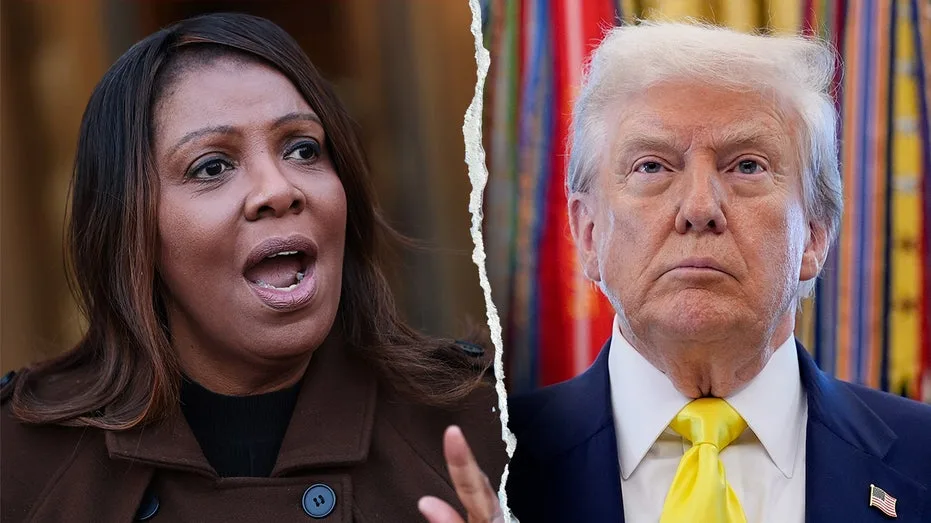
Legal representatives for Donald Trump are seeking clarity on a critical aspect of the civil lawsuit that initially imposed a substantial financial judgment against him. In a letter submitted to the New York Supreme Court on Thursday, Trump's attorneys contend that New York Attorney General Letitia James has not fulfilled a court directive requiring her to outline her office's “preservation practices” and “preservation efforts.” This demand represents the latest in a series of objections from Trump’s legal team, asserting that the case, currently under reconsideration, contains significant flaws.
Trump’s lawyers suggest that James may be withholding crucial evidence, specifically communications involving Michael Cohen, Trump’s former attorney.
“In seeking the discovery, defendants rely on a January 16, 2026 article by Cohen, published on the online platform Substack in which he asserted that, in meetings with lawyers from [James’s] office, he had ‘felt pressured and coerced to only provide information and testimony that would satisfy the government’s desire to build the cases against and secure a judgement and convictions against President Trump,’” a court filing states.
Cohen played a prominent role as a witness in the civil proceedings. During the trial, he contributed to building the prosecution's argument that Trump had consistently misrepresented the value of his assets, testifying that Trump had provided him with specific net-worth targets to achieve.
While the presiding judge denied the request for additional discovery—the process where parties exchange relevant information—he did mandate that James detail the procedures her office has employed to maintain and preserve case-related information. Trump’s attorneys maintain that James has failed to adequately do so.
“[New York Attorney General’s Office] also carefully avoids representing one way or the other whether any requested materials in fact exist, and, if they do, whether NYAG has confirmed that they are being preserved,” they wrote. “Instead of actually complying with the Order, NYAG has simply recited in general terms that her ‘standard litigation hold procedures’ have been in place since the investigation phase of this matter.”
This exchange marks the most recent development in the civil suit initiated by James against Trump in 2022, which accused him of habitually and fraudulently inflating his property values.
Initial Judgment and Subsequent Appeals
Following a finding of liability, Trump was ordered to pay $355 million plus interest in disgorgement. The initial ruling also included bans, prohibiting him from securing loans from any New York bank or financial institution for three years and from serving as an officer or director of any New York company for two years.
An appeals court subsequently overturned the monetary penalties, a decision James has since appealed to reinstate. Trump, for his part, has consistently argued that the entire case is fundamentally flawed and should be dismissed.
Defense Arguments Against the Lawsuit's Merits
Earlier this month, Trump’s legal team outlined five significant weaknesses they believe disqualify the case. They contend that Attorney General James lacked the proper authority to bring the case, emphasizing that it involved private commercial transactions rather than demonstrable harm to the public. They also assert that Trump’s valuations were subjective estimates, which lenders independently assessed, rather than fraudulent misrepresentations.
“The only supposed 'victims' here are a handful of ultrasophisticated banks and insurers that have never claimed to be injured, were eager to do business with President Trump and his family, and made over $100 million from these transactions,” the appeal states.
Furthermore, the defense argues that the prosecution’s core premise of overvaluation relies on a flawed concept that real estate possesses a singular, objective value, and any deviation from that value must constitute fraud.
“Under that breathtakingly broad theory, NYAG can second-guess any business transaction in this State on almost any imagined grounds,” attorneys wrote.
Regarding the penalties, Trump’s representation argues that the $450 million disgorgement is excessive, unlawful, and unconstitutional. Finally, the appeal posits that the politically charged nature of the case alone should have been sufficient grounds to halt its consideration.
“NYAG cannot point to a single Section 63(12) enforcement action against similarly situated developers (or any other type of defendant) based on practices comparable to those alleged here,” the filing states, referencing the state law Trump was accused of violating.
In response, the Attorney General’s Office has stated its objections to the demand for “extrajudicial discovery.”
“Moreover, OAG has completely satisfied its obligations under the Court’s Order for OAG to identify the preservation practices that existed and applied and continue to exist and apply,” the letter from the AG’s office reads.
Related Stories
US Justice Department Reportedly Pauses Antitrust Work with Canada Amid Worsening Trade Feud
The U.S. Justice Department's antitrust division was reportedly instructed to stop all cooperation with Canadian authorities. This directive emerged amidst escalating trade tensions and new tariffs between the
Sep 5

Federal Charges Filed Against Five Individuals for Alleged Election-Related Offenses, Including Non-Citizen Voting
Federal authorities have charged five individuals, two identified as non-citizens, with election crimes such as unlawful voting and fraudulent registration. These actions are part of a broader federal initiative to
Sep 4
New Jersey School District Faces Lawsuit Over Policy Concealing Student Gender Transitions from Parents
A New Jersey school district is facing a lawsuit over its policy allowing students to change their gender identity and name in school records without informing parents. Plaintiffs argue the policy violates
Sep 4

Trump Administration Proposes Stripping Tax-Exempt Status from Schools with Race-Based Programs
The Trump administration has put forth new regulations aimed at removing tax-exempt status from private schools and universities utilizing race in admissions, scholarships, or other programs. This move, following a
Sep 4