President Trump to Award Congressional Space Medal of Honor to Record-Setting Artemis II Astronauts
The four spacefarers made history by traveling farther from Earth than any humans before them during their recent lunar orbit.
Politics·
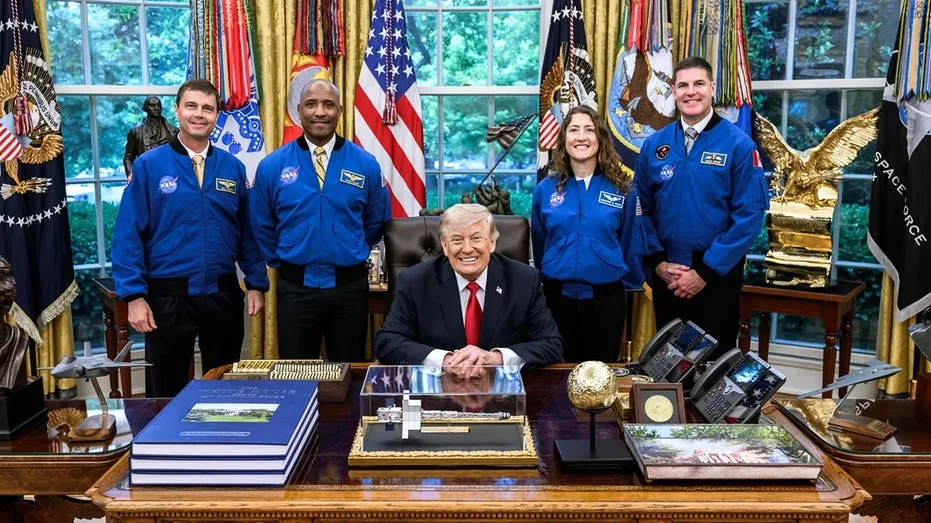
Four astronauts who accomplished a record-setting journey around the Moon earlier this year, traveling further from Earth than any previous human expedition, are slated to be recognized by President Donald Trump.
The President plans to present the Congressional Space Medal of Honor to NASA astronauts Reid Wiseman, Victor Glover, and Christina Koch, alongside Canadian Space Agency astronaut Jeremy Hansen. The ceremony is scheduled for August 28 at NASA's Johnson Space Center in Houston, according to an announcement from the space agency.
These four individuals etched their names in history during April's Artemis II mission, which marked the inaugural crewed voyage of NASA's Orion spacecraft and represented the first occasion in over fifty years that astronauts orbited the Moon.
The Historic Artemis II Mission
NASA confirmed that at its most distant point, the crew reached an astounding 252,756 miles from our planet, thereby exceeding the human spaceflight distance benchmark established by Apollo 13 in 1970. Over the course of their approximately ten-day mission, the astronauts traversed a total of 695,081 miles.
The momentous journey commenced on April 1, as NASA's Space Launch System rocket, generating 8.8 million pounds of thrust, ascended from Kennedy Space Center in Florida. Following in-space testing of Orion's various systems, the crew directed their course toward the Moon, executing an April 6 flyby that brought them within 4,067 miles of the lunar surface, as reported by NASA.
Throughout their expedition, the astronauts documented over 7,000 images. These included breathtaking scenes of earthrise and earthset, detailed lunar craters, ancient lava flows, and a unique perspective of a solar eclipse observed from the Orion spacecraft. Furthermore, NASA stated that the crew noted flashes indicative of meteoroid impacts on the Moon's night side.
Orion successfully re-entered Earth's atmosphere on April 10, traveling at approximately 25,000 mph, before executing a precise splashdown in the Pacific Ocean off the coast of California.
Upon the crew's return, NASA Administrator Jared Isaacman remarked that the astronauts willingly embraced "significant risk" during their comprehensive testing of the spacecraft and its systems, which are designed to facilitate future deep-space missions.
The Congressional Space Medal of Honor
The prestigious medal these astronauts are set to receive traces its origins back to the Apollo era. In 1969, Congress officially authorized the Congressional Space Medal of Honor, affirming that the nation's space endeavors depended on the "intelligence, the dedication, the bravery, and the self-sacrifice" of those astronauts who ventured into the "hostile environment of space."
According to the established legislation, the President holds the authority to bestow this medal, on behalf of Congress, upon astronauts who have demonstrated exceptionally meritorious efforts and made significant contributions to both national and global welfare.
NASA characterizes the recipients of this medal as a "very select group," with its official roster currently listing 30 individuals. This distinguished list features pioneers such as Neil Armstrong, John Glenn, Alan Shepard, and Apollo 13 commander Jim Lovell. Notably, Armstrong was one of six astronauts to receive the medal from President Jimmy Carter on October 1, 1978, as per NASA records.
With the addition of the four Artemis II astronauts, the total number of recipients will rise to 34.
Future of the Artemis Program
Beyond its record-breaking aspects, Artemis II also functioned as a crucial preparatory phase for the ultimate goal of returning astronauts to the lunar surface. NASA confirmed that the crew rigorously tested Orion's life-support systems, engaged in manual piloting of the spacecraft, and collected vital data aimed at refining preparations for subsequent missions.
Looking ahead, NASA intends to conduct tests of commercial lunar lander operations during the Artemis III mission, slated for low Earth orbit in 2027. The agency is then aiming for Artemis IV to achieve the program's inaugural lunar landing in 2028.
Ultimately, the Artemis program seeks to establish a sustainable human presence on the Moon, thereby creating a foundational stepping stone for future crewed missions to Mars.
The astronauts meticulously monitored their spacecraft systems throughout the mission. The Artemis II endeavor, under the leadership of President Trump, captured global attention, ignited inspiration across a generation, and solidified confidence to advance America's return to the Moon to establish a permanent presence. While Artemis III is the next mission in this ambitious campaign, it is during Artemis IV, anticipated in 2028, that NASA astronauts are expected to once again set foot on the lunar surface.
Related Stories

Trump Addresses Rally Interruption, Urges South Carolina Voters to Support Darline Graham in Runoff
Former President Donald Trump campaigned in Myrtle Beach, South Carolina, for Darline Graham. He addressed a rally interruption, telling the protester their mother would be unhappy, and urged attendees to vote in the
Aug 22
Dr. Anthony Fauci's Legal Defense Fund Launched Amid Intensifying Federal and State Investigations
Attorneys representing Dr. Anthony Fauci have established a legal defense fund to cover costs as he faces multiple federal and state investigations. Fauci has denied all allegations of misleading the public during the
Aug 21

Texas Governor Calls for Federal Investigation into Airport Religious Washing Stations, Citing Discrimination Concerns
Texas Governor Greg Abbott has requested a federal investigation into alleged discriminatory religious facilities at two major state airports. He claims Islamic foot-washing stations favor one religion, while airport
Aug 21

Senator Vance Assails Michigan Senate Candidate El-Sayed Over Sharia Law Remarks, Citing Party's Shift
Senator JD Vance criticized Michigan Democratic Senate candidate Abdul El-Sayed over past comments linking Sharia law criticism to White supremacy. Vance argued the Democratic Party has moved away from its working-class
Aug 21