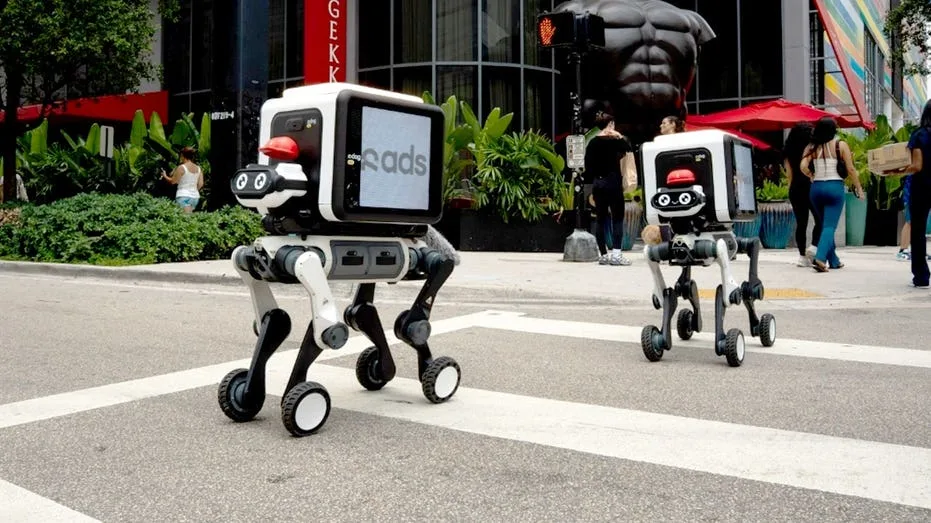
Autonomous robots are increasingly common in various sectors, from security patrols to exploratory missions. However, a persistent challenge for delivery robots remains the final stretch to a recipient's door, particularly when faced with obstacles like stairs. Robot.com, a San Francisco-based company, has unveiled a new solution: R-dog, a four-legged robot designed to tackle these difficulties while also serving as a mobile advertising platform.
R-dog was publicly introduced on August 11, addressing a critical hurdle in robotic delivery: the transition from sidewalk to doorstep. Traditional wheeled robots often perform efficiently on flat, predictable surfaces but encounter limitations with curbs, uneven terrain, or staircases. Robot.com engineered R-dog to cover these crucial final distances, specifically up to 330 feet, by integrating both wheels and articulated legs.
Hybrid Design for Enhanced Navigation
Each of R-dog's four legs is equipped with a wheel, allowing it to traverse smoother ground efficiently. When the path becomes more complex, such as encountering stairs or curbs, its flexible legs are designed to adapt and overcome these impediments. The robot's primary body functions as a cargo compartment, capable of carrying various items, including food orders and standard packages.
The design notably resembles a robot dog, complete with a tail, which the company suggests lends a more approachable appearance compared to typical box-on-wheels delivery machines. This deliberate anthropomorphic design aims to encourage public interaction and comfort, a factor that becomes particularly relevant given its integrated advertising capabilities.
The ability of R-dog to navigate diverse environments could expand the viability of autonomous delivery into areas previously considered challenging for robots. College campuses, residential apartment complexes, and neighborhoods often feature varied routes that can be difficult for wheeled-only systems. The design ensures that the robot can not only surmount obstacles but also deliver packages directly to the intended recipient through an innovative system.
Innovative Delivery and Advertising Model
R-dog's cargo area is designed to hold multiple items, including stacked food orders and e-commerce packages. Upon reaching its destination, an automated drop-off mechanism releases the order, allowing the robot to proceed to its next task without requiring human assistance for unloading. The visual of the package sliding out from the robot's rear has been noted for its resemblance to a dog's defecation, a quirky characteristic that could offer a practical benefit by eliminating the need for recipients to physically unload the machine.
While the robot can carry multiple orders, current information from Robot.com does not fully detail how R-dog identifies and dispenses the correct package when several items are loaded. This aspect, along with the refinement of its storage setup, is an area the company continues to develop as the prototype progresses toward real-world deployment.
Beyond its delivery function, R-dog stands out with its integrated advertising system. The robot features two video screens linked to R-ads, Robot.com's proprietary advertising platform. This allows brands to remotely manage campaigns displayed on the company's fleet of robots.
This business model creates a dual revenue stream: earning from deliveries and from paid advertising displayed as the robot moves through public spaces. The novelty of a four-legged robot with a tail is expected to capture attention more effectively than static advertisements, potentially prompting onlookers to take photos or videos, which could then be shared on social media, amplifying the ad's reach. Robot.com also promotes natural voice conversations, enabling R-dog to interact with people, which could enhance the advertising experience.
The company states that R-ads will offer campaign analytics, though specific details about measurement methodologies and data handling for public interactions are not yet fully clear. These details will be crucial as such machines become more prevalent in busy environments.
Underlying Technology and Company Vision
To ensure safe and effective navigation in dynamic environments, Robot.com is collaborating with FieldAI on the navigation stack for the production version of R-dog. FieldAI's Field Foundation Models are designed to enable robots to operate in real-world settings without extensive prior mapping, allowing R-dog to adapt to unexpected changes in its route, such as newly placed objects or altered paths.
Robot.com manages its robot fleet through its REMI platform, described as a fleet-management platform and physical API layer. This integration means R-dog does not require an entirely new operational system, seamlessly connecting to the existing technology used across Robot.com's other robots. Felipe Chavez Cortes, CEO and co-founder, affirmed this strategy, stating,