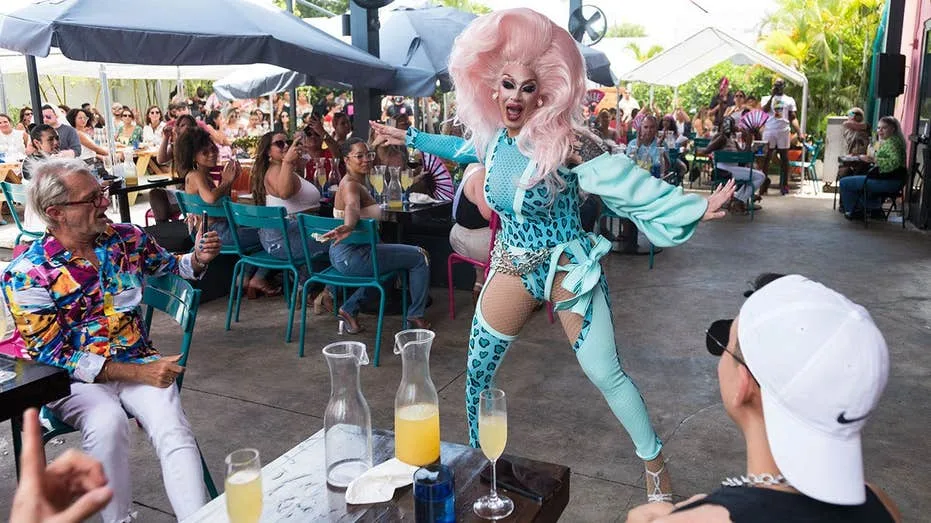
A federal appeals court has paved the way for Florida to implement a state law that limits children's attendance at certain live performances deemed sexually explicit, a measure supported by Governor Ron DeSantis. The ruling specifically affects shows like some drag performances that the state contends are inappropriate for minors.
The U.S. Court of Appeals for the 11th Circuit, in an 8-5 decision on Tuesday, determined that Hamburger Mary’s, an Orlando restaurant, was unlikely to succeed in its legal challenge based on the First and Fourteenth Amendments against Florida’s Protection of Children Act.
This decision fully vacates a previous preliminary injunction and remands the case to the U.S. District Court for the Middle District of Florida for further proceedings. While the ruling permits the immediate enforcement of the law, Hamburger Mary’s retains the option to seek additional judicial review.
Florida Attorney General James Uthmeier lauded the court's decision, posting on social media that it represented a “Huge victory” for his team. He stated that after three years of litigation, the full court affirmed the constitutionality of Florida's prohibition on children attending sexualized drag shows.
Provisions of the Florida Law
The Protection of Children Act classifies it as a misdemeanor to “knowingly admit a child to an adult live performance,” as detailed in the court's opinion.
An “adult live performance” is defined broadly by the statute. It includes live shows that “depict or simulate nudity, sexual conduct, sexual excitement, or specific sexual activities ... lewd conduct, or the lewd exposure of prosthetic or imitation genitals or breasts.” Crucially, for a performance to be prohibited under this law, it must also predominantly appeal to a “prurient, shameful, or morbid interest,” be “patently offensive” for the specific age of the child present and, when viewed in its entirety, lack serious literary, artistic, political, or scientific value for that child's age group.
The Majority's Legal Reasoning
Writing for the majority, Judge Andrew Brasher characterized the Florida statute as a “straightforward regulation of obscenity.”
Preventing children from attending adult live performances obscene for them is rationally related to Florida’s interest in safeguarding the well-being of minors.
Judge Brasher asserted that the state's interest in protecting the well-being of minors is rationally served by preventing children from attending adult live performances deemed obscene for their age.
The majority dismissed arguments from Hamburger Mary’s that phrases such as “lewd” and “the age of the child present” rendered the law unconstitutionally vague or overly broad.
Brasher clarified that Florida Supreme Court precedent restricts the definition of “lewd” to specific sexual conduct. He further emphasized that all three components of the law's obscenity test must be satisfied before a performance can be prohibited.
The court also concluded that using an age-variable standard does not, on its face, make the law unconstitutional.
Eight judges concurred that Hamburger Mary’s was unlikely to prevail on the merits of its constitutional claims. Six judges fully endorsed Judge Brasher's opinion, while Judges Kevin Newsom and Britt Grant joined all sections except for the portion discussing universal injunctions.
Judge Grant offered a separate concurring opinion, stating that a ruling on the scope of the injunction was unnecessary given the court's determination on the merits of the case.
Divergent Judicial Perspectives
Five judges expressed dissenting views.
Judge Robin Rosenbaum contended that the law places an undue burden on venues, forcing them to speculate which performances are appropriate for children of varying ages, while simultaneously exposing operators to criminal penalties, financial fines, and the potential revocation of their business licenses.
Today our Court embraces mess-around-and-find-out (‘MAFO’) First Amendment jurisprudence.
Rosenbaum critically referred to this approach as “mess-around-and-find-out (‘MAFO’) First Amendment jurisprudence.”
She argued that the statute could stifle protected speech by compelling businesses to risk prosecution before understanding how state officials would apply the law.
Rosenbaum also highlighted that the law effectively imposes strict liability regarding a child's age, potentially subjecting violators to incarceration, fines, and the loss of their business license. She dramatically stated that the law “wields a Titanic-sized iceberg of chilling power against protected speech.”
Judge Nancy Abudu submitted her own dissenting opinion, primarily focusing on the legislative history of the law.
Abudu argued that statements made by the law's proponents, coupled with warnings from legislative staff, supported Hamburger Mary’s assertion that the measure would suppress protected drag performances.
The majority, however, countered this point, noting that courts generally do not invalidate an otherwise constitutional law based on allegations of improper legislative motivation.
The majority further clarified that the law contains no provisions specifically targeting performances solely because they involve drag.
Case Background
Hamburger Mary’s initiated its legal challenge in 2023, shortly after Florida enacted the legislation.
The restaurant stated it had previously hosted Sunday drag performances advertised as family-friendly. However, out of concern for enforcement, it canceled these shows and began prohibiting minors from attending its other performances.
Initially, a federal district judge issued a preliminary injunction that temporarily blocked the law's enforcement. A divided three-judge panel of the 11th Circuit subsequently upheld that decision before the full court agreed to rehear the entire case.